Sunday, April 11, 2010

For Latinos, college gender gap growing ~ CHICAGO TRIBUNE

 http://bit.ly/bXvOr6


For Latinos, college gender gap growing

BY SERENA MARIA DANIELS

The Record ~CHICAGO TRIBUNE

CHICAGO — Luis Rivera's life is a delicate balancing act with shifts at the University of Illinois' Chicago campus for as long as 12 hours a day, caring for his two young children and working as a research assistant at the school's College of Medicine.

Luis Rivera, a University of Illinois at Chicago student, drops off  his two children, Cosette, 5, and Andres, 2, at a preschool on campus.  The single father begins medical school in the fall.
CHICAGO TRIBUNE
Luis Rivera, a University of Illinois at Chicago student, drops off his two children, Cosette, 5, and Andres, 2, at a preschool on campus. The single father begins medical school in the fall.


Rivera, of Chicago, will complete his bachelor of arts with a major in Latin American and Latino studies, and is determined to succeed in medical school, which he starts this fall. But when he graduated high school nearly 16 years ago, he, like many of his Latino male counterparts, sidelined a college experience so he could work full time.

"I just felt so uncomfortable — I figured, you know, maybe the school thing just isn't me," Rivera, 33, said recently at UIC's Latin American Recruitment and Enrollment Services office, while holding his son Andres, 2.

Rivera's initial decision to skip college is typical among Hispanic men. While undergraduate enrollment among Hispanic men and women have spiked in the last decade, Latinas are by far outpacing their male counterparts, according to a recent study released by the American Council on Education.


In the past decade, college enrollment among Latina women increased by 70 percent, compared with 56 percent among Latino men, said Jacqueline King, the study's author.


The study, Gender Equity in Higher Education: 2010, was released in January by the council, a Washington, D.C.-based organization that researches education issues.


The gender gap in college admissions seems to have plateaued among other ethnic and racial groups, except for Hispanics, according to the study. And Hispanic men continue to have the lowest bachelor's degree attainment level of any of the groups studied — 10 percent.


Several factors contribute to the disparity between Hispanic men and women attending college, experts say.

In general, immigrant children have a harder time in school than non-immigrants, studies say. And a greater percentage of young adult Hispanic immigrants are male, about two-thirds, compared with female Hispanic immigrants, according to the ACE study.


Non-English speaking foreign-born children and those whose parents are immigrants tend to lack the ability to articulate thoughts into writing and can have difficulties comprehending what they have read, said Theresa Montano, a professor in the department of Chicana and Chicano Studies at California State University, Northridge.

"Imagine that all students are at a starting line, but that Latino children are starting from 2 feet behind [everyone else]," Montano said.


A Pew Hispanic Center study released in October, "Latinos and Education: Explaining the Attainment Gap," showed that about half of the Hispanics surveyed said limited English skills kept them from continuing their education. And the study showed that less than 30 percent of Hispanic immigrants aspire to earn a bachelor's degree, compared with 60 percent of native-born Hispanics.


"Young Hispanic immigrants are not necessarily in the country for school. They're here to work," said Mark Hugo Lopez, associate director at the Pew Hispanic Center and author of the attainment gap report.

Hispanic males struggle with the roles they often play in the household — those of breadwinners responsible for contributing to the family expenses. They are more prone to enter the workforce at an earlier age rather than complete college or even high school, Montano said.


Rivera, the UIC student, chose to work as an electrician after initially dropping out of college. For years, he earned a decent living. But in the back of his mind he knew he wanted to be a doctor, he said.

http://bit.ly/bXvOr6
++++++++++++++++++++++++++++++++++++++++++
Unidos Venceremos! United We Will Win!
~Peta-de-Aztlan~ Sacramento, California, Amerika
Email: peter.lopez51@yahoo.com 
http://help-matrix.ning.com/

http://twitter.com/Peta_de_Aztlan

http://www.facebook.com/Peta51

http://groups.yahoo.com/group/Humane-Rights-Agenda/

http://groups.yahoo.com/group/NetworkAztlan_News/   

"Those who make peaceful revolution impossible,
make violent revolution inevitable."
~ President John F.Kennedy ~ Killed November 22, 1963
c/s


Tuesday, April 06, 2010

Gomez vows to be an advocate for L.A.'s immigrants, the less fortunate

http://bit.ly/dpsuf7

Gomez vows to be an advocate for L.A.'s immigrants, the less fortunate
April 6, 2010 | 11:35 am

Archbishop-elect Jose H. Gomez, shown in 2005. Eric Gay /  Associated Press

Cardinal Roger Mahony on Tuesday introduced Los Angeles to his successor, San Antonio Archbishop Jose Gomez, saying Gomez would be an advocate for the city's vast immigrant community as well as the less fortunate.

"Over the years he has been a most effective leader working with priests serving the Spanish-speaking communities across the country, and his leadership in proclaiming the dignity and rights of our immigrant peoples has helped motivate many people to advocate for our immigrants," Mahony said.

Gomez voiced his unequivocal support for immigration reform and said he wholeheartedly supported Mahony's advocacy for immigrant rights.

Gomez spoke of his joy of coming to Los Angeles, which he said "like no other city in the world, has the global face of the Catholic Church."

He recalled how immediately after he was told about his new appointment, "the first thing I saw was a painting of our Lady of Guadalupe in the hallway. "I felt her love and protection. To Mary of Guadalupe, I would like to entrust my new ministry in the Archdiocese of Los Angeles."


He invited everyone to "thank God for our diversity and to commit ourselves to things that unite us," which he explained were "our service to Jesus, the poor, the defense of the unborn child, the immigrant and the disabled."

Gomez, who was warm and funny in his interaction with reporters, said he had not spent much time in Los Angeles.


"I need to learn about it," he said. "I don't know too much about it."


Mahony, who spoke first, stressed to the pope about the importance of having a Hispanic archbishop. He noted that Los Angeles has the largest Spanish-speaking diocese in the U.S. and the fourth-largest in the world. He said that is the real story today.


He said Gomez's appointment sends a signal around the world that the church supports Spanish-speaking Catholics. "I was so grateful to God for this gift of a Hispanic archbishop," he said.


"I welcome Archbishop Gomez to the Archdiocese of Los Angeles with enthusiasm and personal excitement," Mahony said. "During the process to select a new Archbishop, I urged that the Archdiocese of Los Angeles deserved to have a Hispanic as the next Archbishop. Los Angeles is the largest Hispanic Diocese or Archdiocese in the United States."


Gomez, 58, has risen rapidly through the Catholic church and earned a national reputation. In replacing Mahony, Gomez would instantly become the most prominent Latino bishop in the U.S., leading an archdiocese that by far is the nation's largest and is dominated by parishioners with roots in his native Mexico.


If his personal history is any guide, he also could be expected to guide the Los Angeles church along a more traditional -- some would say conservative -- path than Mahony, known as one of the most progressive archbishops in the country and an impassioned fighter for immigrants' rights.


Gomez is a former member of Opus Dei, a conservative and controversial Catholic organization (known to most Americans because of its unflattering role in "The DaVinci Code," which Opus Dei leaders denounced as misleading and offensive).


Mahony addressed that issue in his statement Tuesday morning: "Some may conclude that since Archbishop Gomez was ordained a priest of Opus Dei he must be 'conservative.' In fact, these labels of 'conservative' and 'liberal' are really unhelpful in the life of the Church. We are all called to a deep relationship with Jesus Christ, and I can attest that both of us share a common commitment to Christ and to the Church, and that both of us are interested in promoting the teachings of the Church fully as well as bringing the words and example of Christ to today's society and world. I consider ourselves to share an equal commitment to the continued growth of the Church here in Los Angeles."


Gomez built a reputation in San Antonio as a staunch traditionalist who reversed some of the more liberal-leaning initiatives of his predecessor. According to local news reports, he disbanded a Justice and Peace Commission whose members disagreed with his support for a state constitutional amendment barring gay marriage, and he once denounced a local Catholic college for hosting then-presidential candidate Hillary Rodham Clinton, an advocate of abortion rights.


Since taking over the San Antonio archdiocese in 2005, Gomez has pleased some members of the community with his strong anti-abortion stance and his insistence on traditional church doctrine, while alienating others who favor a more progressive approach, according to the San Antonio Express-News.

-- Mitchell Landsberg and Jessica Garrison at Our Lady of Angels Cathedral 

Photo: Archbishop-elect Jose H. Gomez in 2005. Credit: Eric Gay / Associated Press
See Video at Websource ~ PSL


RELATED

Photos: Archbishop Jose Gomez

Times coverage on Jose Gomez

Catholics applaud naming of Latino archbishop to head the Archdiocese of Los Angeles


Share your thoughts on Gomez's appointment: Will Mahony successor press for real priest abuse reform?


http://latimesblogs.latimes.com/lanow/2010/04/archbishop-jose-gomez-vows-to-be-advocate-for-los-angeles-immigrants-and-the-less-fortunate.html
+++++++++++++++++++++++++++++++++++++++++++++++++
Unidos Venceremos! United We Will Win!
~Peta-de-Aztlan~ Sacramento, California, Amerika
Email: peter.lopez51@yahoo.com 
http://help-matrix.ning.com/

http://twitter.com/Peta_de_Aztlan

http://www.facebook.com/Peta51

http://groups.yahoo.com/group/Humane-Rights-Agenda/

http://groups.yahoo.com/group/NetworkAztlan_News/   

"Those who make peaceful revolution impossible,
make violent revolution inevitable."
~ President John F.Kennedy ~ Killed November 22, 1963
c/s
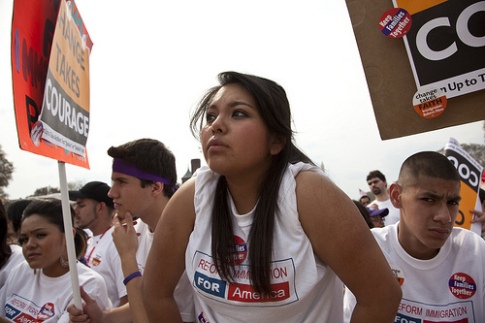

The Face of America’s Tomorrow: The Growing Political Impact of Latinos

http://bit.ly/9UTZSg

The Face of America's Tomorrow: The Growing Political Impact of Latinos

Census, Immigration Blog Add comments

A recent editorial in the Washington Post reminds us that the U.S. Census will have a lasting impact—not only for funding of public services and representation in Congress, but also for securing the role of historically undercounted minority groups such as Latinos. ICE's ramped up enforcement strategy over the last several years has made it more difficult for some Latinos to feel confident that their information won't be turned over to immigration authorities, despite assurances to the contrary. Nonetheless, for a growing group like Latinos, 'not giving their information to government enumerators would reduce the flow of federal funding and even deny themselves representation in Congress.' This year, however, is shaping up to be different.

In the 2000 census, the return rate for Hispanic households was only 69% compared to a non-Hispanic rate of 79%. To reduce that gap, the Census Bureau has spent about 20% of its advertising budget this year on ads aimed at the Hispanic community, hoping to help correct the past return rate. Results from a survey by the Pew Hispanic Center are positive, with 70% of Hispanics saying that the census is good for the Hispanic community. The only troubling result from the survey is that just 69% of foreign born and 57% of native born Hispanics know that the census cannot be used to determine an individual's immigration status.

The 2010 census will also determine state representation in the House of Representatives. The latest Census Bureau data shows Texas gaining four seats, and Arizona, Nevada, Utah, Washington, Florida, Georgia, and South Carolina each gaining one seat. Most of these states have seen growth in the Hispanic population, and Hispanics will likely play a huge role in choosing the new representatives. In fact, the number of Latino voters increased by 28.4%, or 2.2 million, from 7.6 million in 2004 to 9.8 million in the 2008 Presidential election. These gains will, if participation goes as expected, be mirrored in the 2010 census.


Beyond determining representation in Congress, the 2010 census will help allocate more than more than $400 billion dollars of federal funding each year. The funding includes money for hospitals, job training centers, schools, senior centers, bridges and other public works projects, and emergency services. According to a 2009 research report from the Census Bureau, roughly $435.7 billion in federal grant and direct assistance money "was allocated based on Census Bureau data"—including "annual population estimates, Decennial Census data, and other Census Bureau sources"—in Fiscal Year (FY) 2007.


As of 2007, Latinos represent more than 15% of the U.S. population. Although there is no dispute that their votes count, they are likely to count even more if the percentage of Latino households returning their forms increases. That makes the ten questions, ten minutes Census campaign a small but crucial investment in the future.

Photo by Jonathan Laurence

ShareThis


+++++++++++++++++++++++++++++++++++++++++++++++++
Unidos Venceremos! United We Will Win!
~Peta-de-Aztlan~ Sacramento, California, Amerika
Email: peter.lopez51@yahoo.com 
http://help-matrix.ning.com/

http://twitter.com/Peta_de_Aztlan

http://www.facebook.com/Peta51

http://groups.yahoo.com/group/Humane-Rights-Agenda/

http://groups.yahoo.com/group/NetworkAztlan_News/   

"Those who make peaceful revolution impossible,
make violent revolution inevitable."
~ President John F.Kennedy ~ Killed November 22, 1963
c/s


Echo: Presidential "Peacemaking" in Latin America via Noam Chomsky

http://www.chomsky.info/articles/20100105.htm
 
Presidential "Peacemaking" in Latin America via Noam Chomsky
In These Times, January 5, 2010

Barack Obama, the fourth U.S. president to win the Nobel Peace Prize, joins the others in the long tradition of peacemaking so long as it serves U.S. interests.


All four presidents left their imprint on "our little region over here that has never bothered anybody," as U.S. Secretary of War Henry L. Stimson characterized the hemisphere in 1945.


Given the Obama administration's stance toward the elections in Honduras in November, it may be worthwhile to examine the record.


Theodore Roosevelt

In his second term as president, Theodore Roosevelt said, "The expansion of the peoples of white, or European, blood during the past four centuries has been fraught with lasting benefit to most of the peoples already dwelling in the lands over which the expansion took place," despite what Africans, Native Americans, Filipinos and other beneficiaries might mistakenly believe.


It was therefore "inevitable and in the highest degree desirable for the good of humanity at large, that the American people should ultimately crowd out the Mexicans" by conquering half of Mexico and, "It was out of the question to expect (Texans) to submit to the mastery of the weaker race."

Using gunboat diplomacy to steal Panama from Colombia to build the canal was also a gift to humanity.


Woodrow Wilson

Woodrow Wilson is the most honored of the presidential laureates and arguably the worst for Latin America. Wilson's invasion of Haiti in 1915 killed thousands, restored virtual slavery and left much of the country in ruins.


Demonstrating his love of democracy, Wilson ordered his Marines to disband the Haitian parliament at gunpoint for failing to pass "progressive" legislation that allowed U.S. corporations to buy up the country. The problem was remedied when Haitians adopted a U.S.-written constitution, under Marine guns. The achievement would be "beneficial to Haiti," the State Department assured its wards.


Wilson also invaded the Dominican Republic to ensure its welfare. Both countries were left under the rule of vicious national guards. Decades of torture, violence and misery there come down to us as a legacy of "Wilsonian idealism," a leading principle of U.S. foreign policy.


Jimmy Carter

For President Jimmy Carter, human rights were "the soul of our foreign policy."


Robert Pastor, Carter's national security advisor for Latin America, explained some important distinctions between rights and policy: Regretfully, the administration had to support Nicaraguan dictator Anastasio Somoza's regime, and when that proved impossible, to maintain the U.S.-trained National Guard even after it had been massacring the population "with a brutality a nation usually reserves for its enemy," killing some 40,000 people.


To Pastor, the reason is elementary: "The United States did not want to control Nicaragua or the other nations of the region, but it also did not want developments to get out of control. It wanted Nicaraguans to act independently, except when doing so would affect U.S. interests adversely."


Barack Obama

President Barack Obama separated the United States from almost all of Latin America and Europe by accepting the military coup that overthrew Honduran democracy last June.


The coup reflected a "yawning political and socioeconomic divide," The New York Times reported. For the "small upper class," Honduran President Manuel Zelaya was becoming a threat to what they call "democracy," namely, the rule of "the most powerful business and political forces in the country."

Zelaya was initiating such dangerous measures as a rise in the minimum wage in a country where 60 percent live in poverty. He had to go.


Virtually alone, the United States recognized the November elections (with Pepe Lobo the victor) held under military rule -- "a great celebration of democracy," according to Hugo Llorens, Obama's ambassador. The endorsement also preserved the use of Honduras' Palmerola air base, increasingly valuable as the U. S. military is being driven out of most of Latin America.


After the elections, Lewis Anselem, Obama's representative to the Organization of American States, instructed the backward Latin Americans that they should recognize the military coup and join the United States "in the real world, not in the world of magical realism."


Obama broke ground in supporting the military coup. The U.S. government funds the International Republican Institute and the National Democratic Institute, which are supposed to promote democracy.


The IRI regularly supports military coups to overthrow elected governments, most recently in Venezuela in 2002 and Haiti in 2004. But the NDI has held back. In Honduras, for the first time, Obama's NDI agreed to observe the elections under military rule, unlike the OAS and the United Nations, still wandering in the world of magical realism.


Given the close connections between the Pentagon and the Honduran military, and the enormous U.S. economic leverage in the country, it would have been a simple matter for Obama to join the Latin American/European effort to protect Honduran democracy. But Obama preferred the traditional policy.


In his history of hemispheric relations, British scholar Gordon Connell-Smith writes, "While paying lip-service to the encouragement of representative democracy in Latin America, the United States has a strong interest in just the reverse," apart from "procedural democracy, especially the holding of elections, which only too often have proved farcical."


Functioning democracy may respond to popular concerns, while "the United States has been concerned with fostering the most favorable conditions for her private overseas investment."


It takes a large dose of what has sometimes been called "intentional ignorance" not to see the facts.

Such blindness must be guarded zealously if state violence is to proceed on course -- always for the good of humanity, as Obama reminded us again in his Nobel Prize address.


http://www.chomsky.info/articles/20100105.htm
+++++++++++++++++++++++++++++++++++++++++++++++++
Comment: Obama is a hypocrite and the progressive U.S. Left were fools to support him, including myself since I voted for him. I quit the Democratic Party after Obama announced the latest war escalation in Afghanistan. After eight years of Fuhrer Bush I was hoping that Obama would walk his talk. He has done good in domestic policy, despite there being no sane humane immigration legislation, but has failed miserably in foreign policy. Maybe he thinks U.S. citizens won't pay as a much attention to the activities of Amerikan Warlords outside the continental United States.

Unidos Venceremos! United We Will Win!

~Peta-de-Aztlan~ Sacramento, California, Amerika
Email: peter.lopez51@yahoo.com 
http://help-matrix.ning.com/

http://twitter.com/Peta_de_Aztlan

http://www.facebook.com/Peta51

http://groups.yahoo.com/group/Humane-Rights-Agenda/

http://groups.yahoo.com/group/NetworkAztlan_News/   

"Those who make peaceful revolution impossible,
make violent revolution inevitable."
~ President John F.Kennedy ~ Killed November 22, 1963
c/s